Lessons run in Latvian and English: a child can learn in Latvian without speaking English, and the other way round. The learning materials in the studio are in both languages — Latvian and English — and how much of each a child uses is their own choice: in the materials and in conversation with their peers and the guide alike. Some of the day's shared conversations are in Latvian by default; if Latvian is still too hard, a child can speak English in them.
Years 1 to 6 · roughly 6 to 12 years old · An Acton Academy network school · 300+ schools worldwide
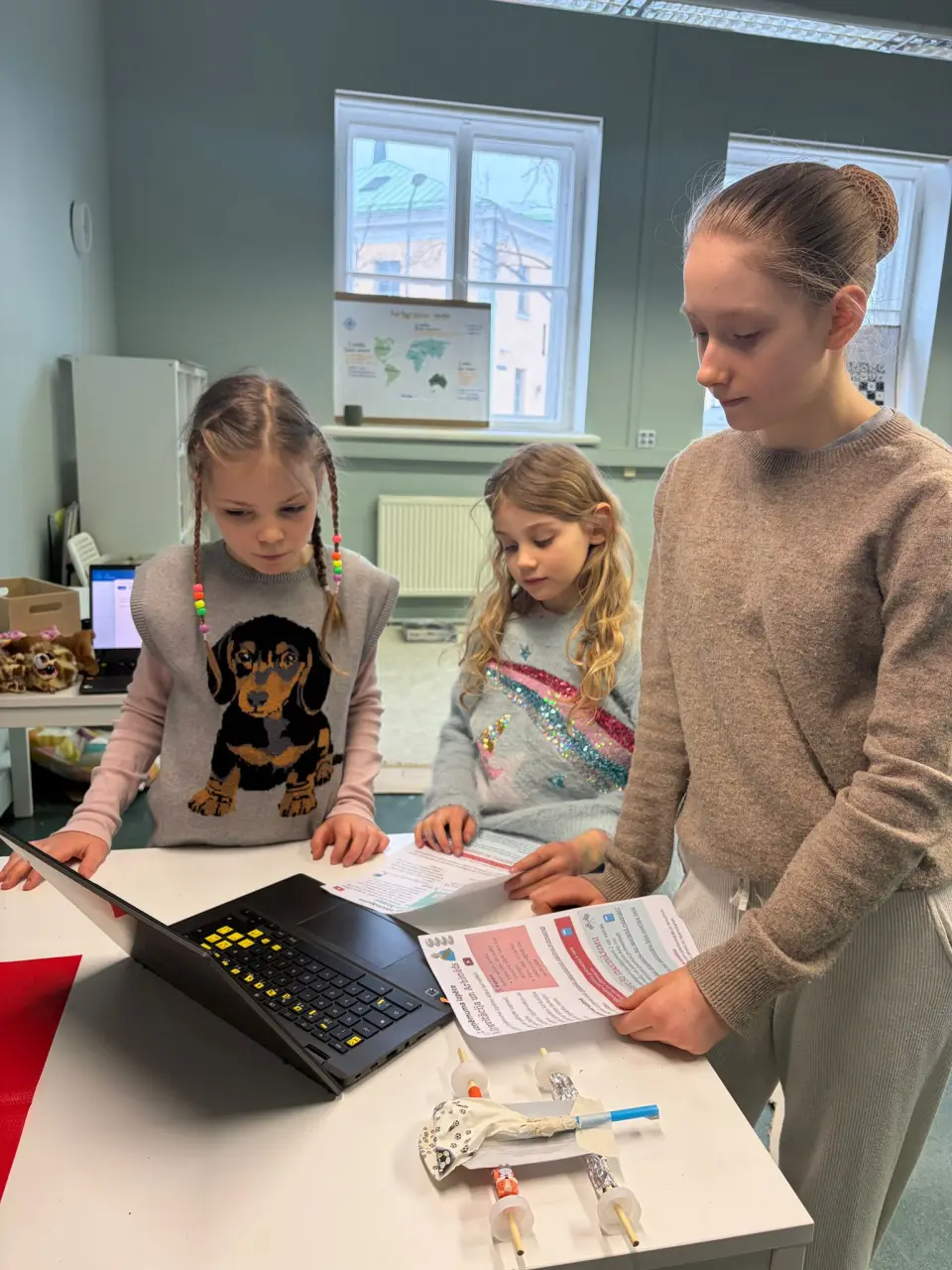
English here is not a separate subject on a timetable, and there is no fixed split across the days either. The materials are in both languages; how much of each to use is the child's choice — in conversation too. The shared conversations are in Latvian, with the option of asking for both languages alongside each other.
The learning platforms for core skills (maths, science, writing, reading), the quest materials (adventure challenges in which school subjects are learned in practice) and the launches for Socratic discussions (15-minute discussions with no right answers) are available in Latvian and in English. The child chooses which language to do a given piece of work in.
The choice is not only in the materials. It is also in who a child talks to and in what language: with their peers, with the guide and in team work. One child uses more English in a day, another less, and it changes over the year.
Some of the day's shared conversations are in Latvian, unless both languages are called for alongside each other. If Latvian is still too hard for a child, they can speak English during the day.
A child gets a question, an explanation or a conversation in the language they need at that moment — without a break in the work and without waiting for a translation.
Written work, presentations and the public exhibitions happen in Latvian or in English, as the child chooses — seven exhibitions a year, one every 6 weeks or so.
The content of the Latvian education standard, the school report and the tests are in Latvian. The children sit the national diagnostic assessments here too.
In practice this means the language becomes a tool. No child waits for "enough" language to start real work.
Here is what happens, in order.
The child works in English: the materials are in both languages, and the conversation with the guide happens in the one they already have. They do not have to get through a language course before starting.
They hear Latvian all day from their peers: at the peace table, at the studio meeting, over snacks and in team work. It is the language the life of the studio mostly happens in, so the reason to use it is there every day.
A child presents their first public piece of work in the language they feel safer in. For the next quest and the work after it they usually choose the language themselves too.
Reading, writing and maths are learned to mastery on each child's own plan, so their Latvian does not hold the rest of the learning up. A child stays with what is not learned yet and moves on in what is.
Acton Academy is a network of 300+ schools worldwide, and all of them follow one and the same learning design: a mixed-age studio, quests, the badge plan, an exhibition at the end of the session. A child who moves from Riga to another Acton Academy — to Ventspils, say, or to Austin in the United States, where the network began — finds the same structure to the day. That is exactly what is usually lost in a move — not the curriculum, but the way the day is put together.
Our programme is state-licensed, so a child can move to another school at any point and carry on. Staying in Latvia, a child moves to any other school with a report and a record in the state education register (VIIS).
A family in Riga who wants strong English for their child usually looks at three options. Each solves a different problem, and they cost very different amounts.
| Criterion | The international schools | A state school with English | Acton Academy |
|---|---|---|---|
| Language of instruction | English; Latvian as a separate subject | Latvian; English as a subject on the timetable | Latvian; materials in both languages and the choice left to the child |
| Programme | The IB or Cambridge international programme | The Latvian state programme | A programme licensed in Latvia, within the Acton Academy self-directed learning model |
| The connection to Latvia | The child grows up in an international environment | The child grows up in a local environment | A Latvian school with Latvian peers and international content |
| Who it suits best | Families who are in Latvia for a time and are planning the IB route | Families for whom English as a subject is enough | Families who live in Latvia and want their child to have the chance to use English every day as well |
| School | Published tuition | School year |
|---|---|---|
| Exupery International School | approximately 12,800–22,400 EUR a year | 2026./27. |
| International School of Riga | 10,800–19,400 EUR a year, plus entrance fees | 2026./27. |
| International Montessori School of Latvia | approximately 9,900–11,100 EUR a year | 2025./26. |
| Acton Academy | 650 EUR a month | 2026./27. |
The figures are the schools' own published ones for the school year shown, not our calculation. One of them is still on a 2025/26 basis. Tuition at these schools changes every year.
Ours is given per month, the others per year. What is included in our tuition and what the discounts are is on the tuition page. For the programme licence and the paperwork, ask in the admissions conversation or see the admissions page.
Yes. On the first day they work in English: every material is in English as well, and the guides speak both languages fluently. They pick Latvian up from the everyday life of the studio — in conversation with their peers, at the peace table and at the studio meeting, where the life of the studio mostly happens in Latvian. Some of the day's shared conversations are in Latvian, unless both languages are asked for alongside each other. If Latvian is still too hard for a child, they can speak English in them.
Yes. The child works in Latvian — the same materials are in Latvian too — and starts using English at whatever pace they are ready for. English comes from using it, so nobody waits for a separate English course before starting a quest.
That is set by the child's own choice, which is why we do not put a figure on it here. The materials are in both languages, and they can use English in those and in conversation with the guide and their peers. The state programme, the school report and the tests they do in Latvian.
No — we are a Latvian private school with an international network as our foundation. The international schools in Riga offer the IB or Cambridge programme in English, and their fees run to tens of thousands of euros a year. We teach a programme licensed in Latvia, within the Acton Academy learning model; the tuition is on the tuition page.
Yes. A child takes the state programme in Latvian: the content of the Latvian education standard and its assessments are in Latvian. The English of daily life sits alongside them. The children sit the national diagnostic assessments here too.
Whichever is easier for the family — Latvian or English. The introductory conversation, the studio visit and all the correspondence can be in English.
A child needs to read and write at least at a basic level. One of the two languages is enough — they will start reading the other in the studio, when the material calls for it.
Book an open day — find out about the materials in both languages and see what language options your child will have.
3 places left for this year (the 2026/27 school year). · Kronvalda bulvāris 1, Riga
If you agree, Meta Platforms Ireland (Facebook, Instagram) receives information about which pages you open, what you click on and whether you submit a form, together with your IP address, browser data and Meta cookies. That is how we see which of our ads are useful to parents. Without your consent we send nothing to Meta. You can change your choice at any time at the bottom of the page (“Cookie settings”).