
Comparison
Montessori or Acton Academy Riga?
Many Riga families looking for a school with independent, child-centred learning compare Montessori and Acton Academy Riga. Before Maria Montessori became an educator, she was a scientist — a doctor who observed children closely and built her method from what she actually saw, not from what adults assumed to be true. More than a century later, many of her insights about learning have been confirmed by modern research.
This page is for a parent looking at Montessori who wants to know where Acton Academy Riga is the same and where it is not. If you are weighing Waldorf against Montessori as well, start with the Waldorf, Montessori and Acton comparison in one table.
“Help me to do it myself.”
— Maria Montessori
What research confirms and what we keep
When Angeline Stoll Lillard gathered the evidence for what works in Montessori methods, describing it in her book Montessori: The Science Behind the Genius, she found that several of Montessori’s core ideas align with the best-supported findings in learning psychology. That is part of why Montessori still thrives today — its methods get results.
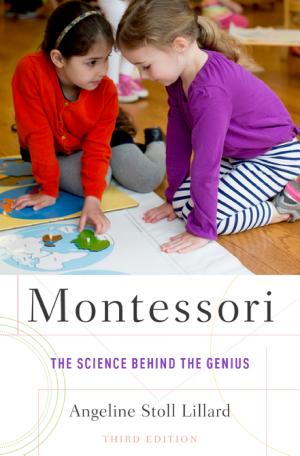
Montessori: The Science Behind the Genius
Angeline Stoll Lillard
Mixed-age classes
Montessori groups children in three-year age bands, and not without reason: research shows that children learn especially well from slightly older peers. In turn, older children reinforce their own skills and knowledge by teaching younger ones.
| Montessori | Acton Academy Riga |
|---|---|
| Mixed-age groups in three-year bands: 3–6 years, 6–9, 9–12, ... | Mixed-age groups, but grouped by readiness, not only by age. |
Long, uninterrupted work blocks
Montessori’s three-hour “work cycle” is not simply a scheduling choice — it is about attention, and research backs it up. Deep concentration only sets in after roughly 60–90 minutes. Blocks shorter than about three hours rarely reach the state where the best work happens.
| Montessori | Acton Academy Riga |
|---|---|
| An uninterrupted three-hour work cycle. | Long time blocks that allow learners to reach flow. |
Learning without grades
One of the most durable findings in motivation psychology: external rewards such as grades, stars and prizes measurably undermine intrinsic motivation, creativity and depth of learning. Montessori understood this early, back in the last century.
| Montessori | Acton Academy Riga |
|---|---|
| No grades — observation and mastery instead. | No grades — instead, public exhibitions and earned badges as proof of mastery, much like an earned certificate or a scout badge. An earned achievement, not an external rating. |
Student-directed, prepared environment
The child chooses their own work and moves at their own pace, in an environment with minimal adult intervention during moments of deep engagement. That is the Montessori spirit, and Acton Academy Riga keeps an environment that supports it.
| Montessori | Acton Academy Riga |
|---|---|
| A prepared environment; the child chooses the work. | A prepared environment; the child chooses the work, but with more structure and support. |
An environment without fear
Real choice and the absence of fear of grades create the strongest predictor of a child’s motivation to learn: a positive emotional climate. Both Montessori and Acton Academy Riga are built to create it.
| Montessori | Acton Academy Riga |
|---|---|
| Choice, without fear of grades. | Choice, without fear of grades. At Acton Academy Riga, extra freedom is earned gradually, growing along with the responsibility taken on. |
“The greatest sign of success for a teacher is to be able to say: the children are now working as if I did not exist.”
— Maria Montessori
Where and why Acton Academy Riga differs from Montessori
Montessori materials → open-ended quests
| Montessori | Acton Academy Riga |
|---|---|
| Materials with one intended use — a precision that makes early sensory and motor training effective. | Quests — multi-week collaborative projects in which learners tackle open-ended problems and often invent their own solutions. |
Why: we also use Montessori materials for individual work, but especially in the older grades we aim for a different outcome — independent problem-solvers who are resourceful and adaptable. That takes creative freedom, not a single correct answer.
The quiet guide → the Socratic guide
| Montessori | Acton Academy Riga |
|---|---|
| The teacher (guide) is a quiet connector between the child and the material — demonstrates, then steps back. | The teacher (guide) is Socratic — asks hard questions, leads discussions and encourages learners to think aloud and defend their views. |
Why: part of our mission is to raise confident, critical thinkers who can defend an idea and persuade others, including at public exhibitions in front of a real audience.
The role of parents
| Montessori | Acton Academy Riga |
|---|---|
| The classroom is a protected space for the child’s independence. Montessori mainly addresses what happens in the classroom, and says little about the parents’ role outside it. | The studio, like a Montessori classroom, is a protected space for learners, and we too do not ask parents to run or manage its day-to-day life. But outside the studio, we deliberately give families resources, encouragement and inspiration to continue the hero’s journey at home, and at exhibitions parents are a real audience the learners present to. |
Why: the family is a partner in the child’s growth — not inside the studio, but in the child’s hero’s journey, which continues beyond the school walls.
What Acton Academy Riga adds
- The hero’s journey as a learning framework. Every learner is on their own hero’s journey to find a calling that will change the world. Montessori builds independence and confidence; we add to that a personal mission narrative that drives growth.
- Socratic discussions and teamwork every day. In addition to individual work with materials, learners think aloud and learn from one another every day — building skills of persuasion and critical analysis.
- Public exhibitions for a real audience. Learners demonstrate mastery not only by having a guide observe them, but by presenting in front of a real audience. This builds accountability and confidence.
- Collaborative projects — quests with a real outcome. Multi-week quests with a real outcome, such as a business fair, teach open-ended problem-solving and adaptability.
- Modern technology for core skills. We use technology where it offers something more than hands-on work. But hands-on, collaborative activity remains the primary and most engaging way to develop.
Is Acton Academy Riga a Montessori school?
Much of Maria Montessori’s work has remained relevant to this day — she studied what works in children’s education, rather than deferring to what the systems of her time said.
Lillard’s research found something important: “watered-down” Montessori — where the name stays but grades, teacher direction or single-age groups quietly creep back in — loses most of the measured benefit compared with classic Montessori.
If you want a Montessori school, look carefully — the name can be misleading. We take a different name and a different approach: we have taken Montessori’s evidence-based mechanisms and built them into our own, distinct and coherent system, with the hero’s journey, quests and Socratic guides.
Summary
Where we overlap
| Principle | Montessori | Acton Academy Riga |
|---|---|---|
| Mixed age | Three-year bands | Mixed age, but not necessarily in 3-year bands |
| Work blocks | 3-hour work cycle | Long blocks that allow flow |
| Grades | None. Observation and mastery instead | None. Exhibitions and badges instead (an earned achievement, not an external rating) |
| Prepared environment | The child chooses the work | Choice, with more structure and support |
| Emotional climate | Choice, without fear | Choice, without fear; freedom grows with responsibility taken on |
Where we differ
| Dimension | Montessori | Acton Academy Riga |
|---|---|---|
| Main activity | Materials with a single use (we also use Montessori materials at Acton Academy Riga) | Collaborative quests (projects) with a real outcome |
| Adult’s role | Observes, demonstrates, steps back | A Socratic guide who asks, suggests and models |
| Parents’ role | Montessori says less about the parent’s role | Partners outside the studio, plus an audience at exhibitions |
| Technology | Limited (and that’s not a bad thing) | Modern tools, where they add value |
Montessori education has proven itself and is arguably the single biggest philosophical inspiration for Acton Academies. We are a school built for the 21st century on some of what we consider the best Montessori ideas.
Acton Academy Riga and Montessori share one calling
Acton Academy Riga’s mission is to inspire every child to find their calling and change the world. Montessori aims for the same thing — helping a child grow into an independent, whole person who benefits others. That is why, in many ways, we walk hand in hand.
- In both schools, the child learns on their own and at their own pace — because they want to, not because they are told to.
- Both care not only about knowledge, but also about character and what the child will do with their life for the benefit of others.
- Montessori showed how a child develops and how to set up an environment that supports that natural development. Acton Academy Riga builds on the same foundation and adds more: real collaborative projects and entrepreneurship, self-set goals and community work, prompts that build critical thinking, studios that model a small civil society, and structures that further support taking responsibility and self-motivation.
Montessori speaks more about a child’s natural development and their place in the world. Acton Academy Riga tells that story through each child’s personal hero’s journey.
Some call Acton Academy Riga Montessori for the 21st century, or Montessori 2.0, or Montessori+. There is some truth to that, since both build learner-driven learning communities, but Acton Academy Riga does it in a 21st-century context.
Is this the right school for your family?
Fifteen minutes, no commitment — you ask, we answer. In English, whenever it suits you.